
Carroll Shelby liked going fast. If that sounds like an oversimplification of someone who left indelible marks on motorsport as both a driver and a constructor, perhaps it is — but it gets to the heart of a man who set a multitude of speed and course records, won 50 races from 148 starts (including the legendary 24 Hours of Le Mans and the 1960 USAC Road Racing Championship), and was named Sports Illustrated’s sports car driver of the year in 1956.
@barrettjacksontv Carroll Shelby didn’t just want to dominate #Ferraris on the track, he wanted to beat them on the street, too. That vision gave rise to #LittleRed, an experimental #Shelby #GT500 unlike anything else. For decades, this legendary car was thought to be lost forever … until we found it. Watch more of “The Hunt for Little Red” on @youtube ♬ original sound – Barrett-Jackson
Unfortunately, it was the heart of the man that got to him, with angina pectoris forcing Shelby to retire from racing in 1960. However, this didn’t douse his lust for the fast and furious, as he dreamt of creating something akin to — but more reliable than — the Aston Martins, Ferraris, Jaguars and Maseratis he had driven during his racing career.
US + UK
Though in thrall to the speed of these iconic sports cars, Carroll Shelby was less impressed by what he saw as an inherent unreliability, with engines that required frequent maintenance. Why not, he reasoned, pop a good old American V8 engine into one of these lightweight, nimble vehicles?
His dream became a reality when he learned that British manufacturer AC Motors could no longer source the engine required for their AC Ace sports car. Shelby pitched his idea to AC Motors, who loved it, then to Ford Motor Company, who were taken with the idea of a car that could go head-to-head with the Chevrolet Corvette.
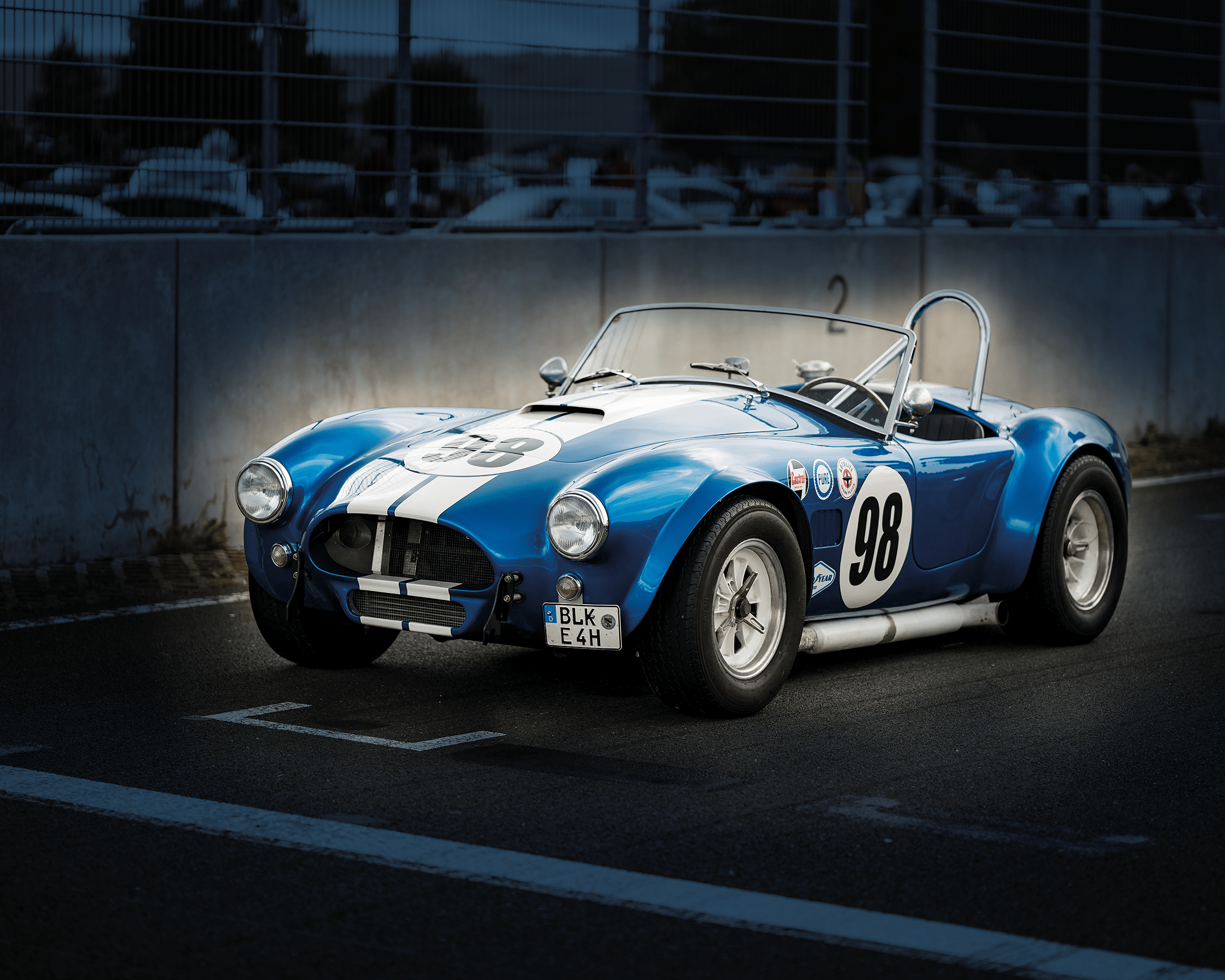
Thus the newly formed Shelby American and AC Motors set to work, crafting something hitherto unique: a sports car that fused British engineering with American muscle. Shelby dubbed it ‘the Cobra’, a name he said came to him in a dream.
While the goal was to maintain the lightweight form factor of the Ace, when building the prototype, engineers had to beef up the body somewhat to accommodate the significantly greater power of a V8 engine. That meant fitting a limited-slip Salisbury rear differential, inboard rear disc brakes to reduce unsprung weight and improve handling, and thicker main chassis tubes.
The result was the prototype Carroll Shelby Experimental 2000 (although just ‘CSX2000’ was engraved on the chassis), which was tested at the Motor Industry Research Association track in England, using the new Ford Fairlane 221 CID V8 engine.
Finally, in February 1962, the chassis was flown to America to be fitted with a four-speed transmission and one of the very first Ford 260 CID V8 engines, at hot-rodding legend Dean Moon’s auto shop in Santa Fe Springs in California.
Smoke, mirrors + yellow paint
Two months later, the Cobra CSX2000 debuted at the New York Auto Show, decked out not in the iconic blue that came to be associated with the car, but in pearlescent yellow paint that Shelby was advised would look striking beneath the harsh glow of fluorescent lighting.
It was the first of many paint jobs on the sole prototype with which Shelby did the rounds, creating the illusion that the cars were rolling off the production line.
Thankfully, production did get going and 75 cars were sold by the end of 1962. The performance was truly mind-blowing for a street-legal vehicle, clocking 0-96km/h in four seconds and with a top speed in excess of 265km/h.
But Shelby didn’t design the Cobra merely to tear up the streets.
The car emerged as a powerhouse in American motorsport in the early 1960s, winning multiple races in the US Road Racing Championship and Sports Car Club of America events.
To compete with Ferrari’s GT cars, Shelby knew that modifications had to be made to the Cobra, resulting in the Shelby Dayton Coupe, which helped the manufacturer clinch the International Championship for GT Manufacturers in 1965.
One for the dreamers
With its timeless looks, innovative marriage of steel frame with lightweight aluminium body, and that monster engine — with the consequent eye-watering performance and track success — the Cobra quickly established its legacy as a pioneer of US motorsport excellence. Elvis Presley drove one in the 1966 film Spinout, and the car featured in the hit TV crime series Honey West, cementing its place in popular culture.
Fewer than a thousand were manufactured, making it a collector’s item of the highest order, with originals selling for more than $1 million today.
More than that, however, the Cobra remains a symbol of American innovation, an inspiration for designers and engineers the world over… and a reminder of what can happen when dreams become reality.
@polloloco_cars Mclaren M1A Oldsmobile, amazing V8 sound! #fyp #foryou #foryoupagee #mclaren #mclarenm1a #elvispresley #elvis #v8 #v8power #theicestmoritz ♬ som original – bakura
Words: Anthony Sharpe
Photography: Unsplash, Gallo/Getty images
Also read: These car brands are eager to be the best